
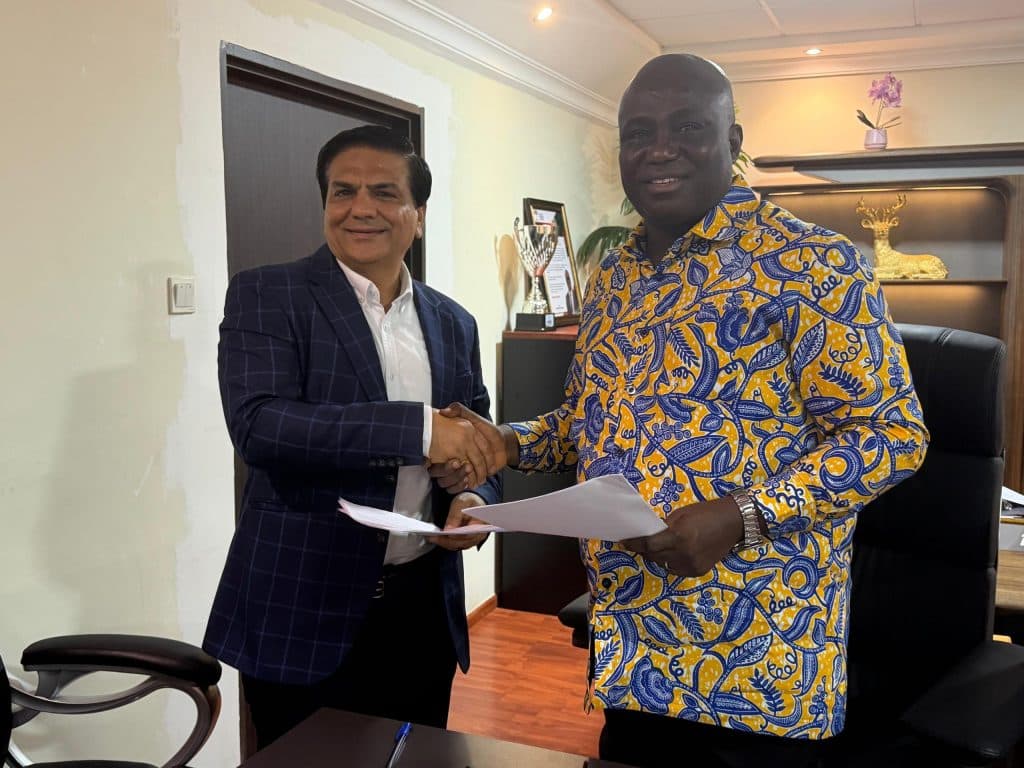
Ghana has ignited a bold new chapter in its agro-industrial transformation with the signing of a landmark Memorandum of Understanding (MoU) to establish a major cashew processing plant aimed at boosting value addition and creating thousands of jobs.
The agreement, signed between the Ministry of Food and Agriculture (MoFA) and B5 Plus Limited, marks a decisive shift from exporting raw cashew nuts to building a powerful local processing industry.

The Minister for Food and Agriculture, Hon. Eric Opoku, and Executive Director of B5 Plus Limited, Mr. Mukesh Thakwani, formalised the partnership at a ceremony that signals Ghana’s determination to turn agricultural abundance into industrial strength.
“This is not just about producing more crops,” Hon. Opoku declared. “Feed Ghana is about building industries around what we grow.”
Ghana is one of Africa’s leading producers of raw cashew nuts, yet much of the crop leaves the country unprocessed — denying farmers and the economy the full value of the commodity. This new project aims to reverse that trend.
Under a Build-Operate (BO) model, B5 Plus Limited will finance, design, construct, equip, own, and operate the state-of-the-art facility at its own cost and risk, pending regulatory approvals. Meanwhile, the Ministry will provide policy coordination, land facilitation, stakeholder engagement, and support with inter-agency approvals to ensure seamless execution.
The vision is clear: process locally, create jobs locally, and retain wealth locally.
“When we process our cashew here at home, we create employment, empower farmers, and keep Ghanaian wealth within Ghana,” the Minister emphasized.
Beyond infrastructure, the initiative places strong emphasis on sustainable sourcing and farmer inclusion. Transparent grading systems, prompt payments, and structured farmer engagement programmes are expected to stabilise incomes and reduce post-harvest losses.
Industry experts say domestic processing will deepen rural industrialisation in cashew-producing regions, improve farm-gate pricing, and reduce Ghana’s reliance on exporting raw commodities only to re-import finished products at higher costs.
The project will also drive skills transfer and capacity building, equipping Ghanaians with technical and managerial expertise in agro-processing.
The MoU aligns with Ghana’s broader industrialisation and export diversification agenda. While the agreement is non-binding and subject to further definitive arrangements, it establishes a clear implementation roadmap, including the formation of a Joint Technical Committee to oversee planning and milestones.
Government support measures — including regulatory facilitation and lawful export management tools — may also be considered in line with due process.
More than an industrial investment, the cashew processing plant represents a strategic economic pivot.
“The era of exporting raw potential is over,” Hon. Opoku declared. “Under Feed Ghana, we are turning harvest into industry and agriculture into the engine of economic transformation.”
As global demand shifts toward processed agricultural products, the MoFA–B5 Plus partnership positions Ghana not just as a producer of raw cashew, but as an emerging value-added agricultural powerhouse.
If successfully executed, this project could become the blueprint for similar investments across Ghana’s tree crop sector — accelerating the country’s journey from commodity dependence to full-scale industrial transformation.



