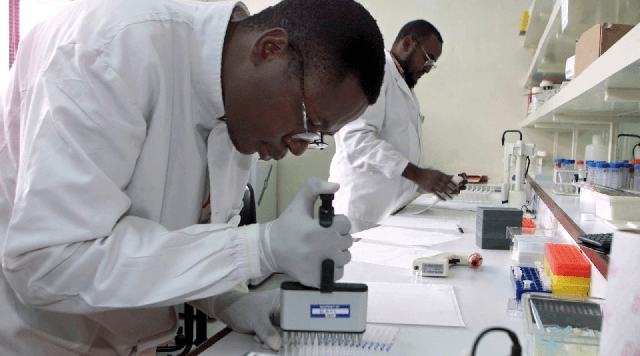
Ghana’s Korle Bu Teaching Hospital is the first of its kind, built in 1923. The teaching hospital is a government referral centre in Ghana. In recent days, a dispute has arisen between Medical Laboratory Scientists (Lab Scientists) and the Korle Bu Teaching Hospital Medical Doctors’ Association (Korle Bu Doctors).
The nature of the dispute from a Technoscience perspective – a perspective of the power, promise and potential of things – is a dispute about how to know the reality of diseases. The issue, therefore, is a philosophical dispute that requires sober deliberation.
Unfortunately, the Korle Bu Doctors and Lab Scientists seem to suggest the problem lies with the leadership of the teaching hospital’s Central Laboratory – the facility where the Lab Scientists work. In response, Mr Emmanuel Akomanin Asiamah went on to proffer a medical lab governance solution.
Admittedly, both the Lab Scientists and Korle Bu Doctors have been battling for the leadership of the laboratories for a long time, but the claim the doctors are making concerning test results in the laboratory where pathogens are involved is not simply about governance.
The trend of the dispute and solution so far does not explain the reality of pathogens and how that is affecting the dispute for the public to understand.
In that regard, pathogens are like chameleons. That is, a pathogen can turn blue under clinical observation, and to Lab Scientists, the same pathogen can turn yellow under a microscope.
In the case between the Lab Scientists and the Korle Bu Doctors, the issue is not about the chameleon changing colours of a pathogen, but rather about how to identify the signals of the disease-causing organism in the lab.
The difficulty is that the physical eyes of the lab scientists cannot observe pathogens. Lab Scientists rely on microscopes and chemicals to help visualise and identify the pathogen.
The accuracy of the microscope, the chemical and the eyes of the lab scientist then become very critical to identifying the character of any particular pathogen that is causing sickness in a patient.
Assuming the microscope, chemical, and the eyes of the Lab Scientist are accurate, if the method of taking the sample containing the pathogen from the patient was compromised, would it not affect how the pathogen behaves under the Lab Scientist’s microscope?
During the inaugural lecture by Nicholas Dzifa Dayie of the University of Ghana, the answer would seem to be yes.
Professor Dayie went on to say that some people seem not to trust lab results from government hospitals but trust those of private hospitals. According to him, lab results from private hospitals are not foolproof either.
As part of his inaugural professorial lecture titled When Microbes Speak, and Data Appear Inconsistent, Are We Witnessing Falsehood or Truth?, Professor Dayie addressed the struggle inherent in this issue.
In the particular case here, this issue is about the reality politics of pathogens, the same issue causing a rift between two professional groups at the Korle Bu Teaching Hospital.
Professor Dayie situated truth in this context as “genuine microbial reality”. He defined the opposite of truth, falsehood, as “distortion introduced by weak laboratory systems, poor diagnostics, inconsistent methods that fail to accurately reflect what the microbes are truly saying”.
When the lab systems become “weak” at any time, or the microbes change like a chameleon, or it is an entirely different pathogen that both the lab scientists and laboratory systems have not been designed to detect accurately, at what point would the lab scientists know there is “falsehood”?
What compounds the problem is that, at the clinical level, doctors are the first to observe a patient who is carrying a pathogen.
These doctors too do not see pathogens with their physical eyes; what they do see is the patients’ behaviour as a result of the pathogen, and also from what patients report about their sickness.
This kind of observation forms a certain reality of what the disease may be in the mind of the doctor. It is for this reason that a doctor may need confirmation about the truth or reality of a pathogen from the lab scientists.
For this reason, Korle Bu Doctors and Lab Scientists are hanging on to a form of reality — specifically, reality politics about pathogens.
This is why the dispute between doctors and lab scientists is philosophical, and each side could be right.
The winner of this philosophical contest about reality politics will be the professional group that can mobilise enough public support.
Already, management of the Korle Bu Teaching Hospital has asserted that the lab results are “valid and reliable”.
The evidence presented by management is based on what they know to be the qualifications of the lab scientists, as well as the international certification of the Central Laboratory.
A lab can have the best professionals, but a pathogen can mislead even the best-trained lab scientist. When that happens, it does not mean the lab scientist is unqualified.
In the view of Professor Dayie, it simply means the entire system of human resources and instruments is not accurately capturing what pathogens are signalling. In such situations, new methods and equipment are needed to investigate the pathogens.
This is why when conversations about this reality politics are presented as a lab governance problem to the public, the public may cast a vote of confidence or no confidence in the two professional groups.
However, that would not be helpful in properly situating the issue at stake.
For a solution, the management of the Korle Bu Teaching Hospital should rather take the evidence of both the doctors and the Lab Scientists and test the same evidence at different facilities to resolve this reality politics.
If the words of renowned Ghanaian poet Kofi Awoonor are anything to go by, this reality politics about pathogens is like “chameleon faeces”; if it is not dealt with immediately, it will linger for a while, and the public can lose confidence in the teaching hospital.
The author of this piece is Jonathan Bill Doe, a student of Heritage Studies and Technoscience Studies at Brandenburg University of Technology.