
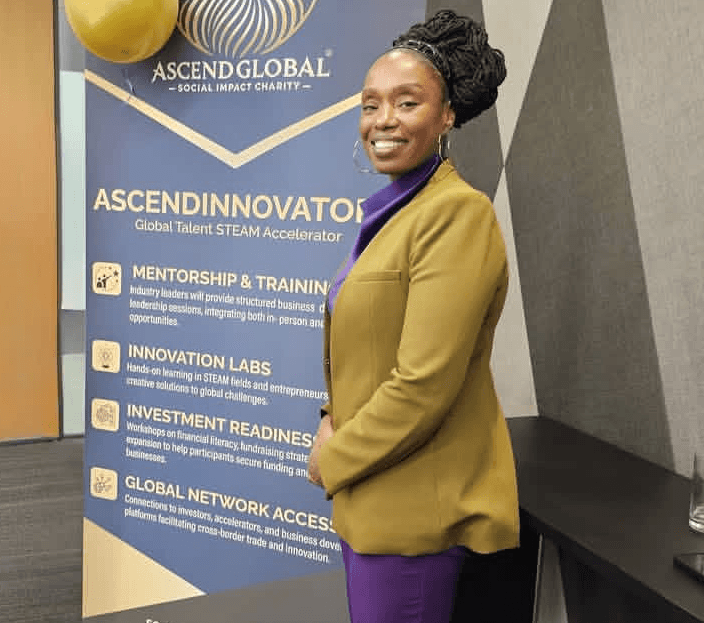
Former US diplomat and global social impact strategist Rebeća Lewis has called for stronger support from Ghana’s private and public sectors for initiatives aimed at preparing young people, particularly women, for opportunities in science, technology, engineering, arts and mathematics (STEAM).
Ms Lewis, who is the founder and CEO of Ascend Global Impact, said her organisation’s work in Ghana is focused on equipping young women with mentorship, entrepreneurship skills and access to global networks to help them turn their ideas into viable ventures.
Speaking on Good Afternoon Ghana on Metro TV, she said the initiative, known as Ascend Innovators, began in Ghana in 2025 with about 20 young women at university level and has since grown to more than 60 participants.
“We have about maybe 60-something young ladies that will be in Ghana. Ghana is now our biggest chapter,” she said.
According to Ms Lewis, the programme goes beyond classroom training by pairing participants with experienced STEAM professionals and providing regular masterclasses.
“We have not only paired them one-on-one with mentors that look like them, black STEAM women leaders globally. We also run master classes,” she said.
The sessions cover areas including artificial intelligence, project management, programme management and confidence building, with participants also given the opportunity to identify areas where they need additional support.
Ms Lewis said one of the biggest changes she has observed among the young women is an improvement in their confidence.
“We spoke about confidence. That has been the number one thing that we see,” she said.
She cited the experience of some participants who have gone on to pursue entrepreneurship, including a young woman who has started a fintech business.
Ms Lewis believes the broader objective should be to help young people become economically independent and contribute to solving challenges within their own communities.
“The whole purpose of this is to close the generational wealth gap amongst us as a global black community,” she said.
She explained that Ascend Global Impact deliberately started its programme in Ghana after she felt drawn to the country during her first visit to West Africa.
“The first time I came to Ghana, I knew that this was where my spirit was pulling me to start,” she said.
She has since visited Ghana six times in about a year and a half and said the organisation is building a wider network that will eventually extend to other countries.
“We’re creating this global ecosystem of sisterhood,” she said, adding that the programme is also being implemented among young Black women in the United Kingdom, with plans to expand to Nigeria.
Ms Lewis stressed that the organisation does not intend to impose solutions on African communities but rather wants to equip young people to develop responses to challenges in their own communities.
“We totally understand that it is not our job to create solutions for a region that we haven’t been born into naturally,” she said.
“We empower our young ladies to really be the solutions to their problems for their specific communities.”
On entrepreneurship, Ms Lewis advised young people not to wait for funding before taking the first steps towards their ambitions.
“The most important thing is to have that vision and to put action towards it. So it’s not necessarily waiting for the funding to come in,” she said.
She acknowledged that entrepreneurship can come with difficulties and urged young people to understand that financial success is only part of the journey.
“There is sometimes, you know, struggle that may come in the middle,” she said.
Ms Lewis also encouraged young women to develop courage and faith as they pursue their goals, arguing that they do not need to have every stage of their journey mapped out before taking action.
“If you have enough faith, you take the first step and then things start to line up,” she said.
She ultimately appealed to both government and businesses to support programmes that create opportunities for young people.
“We would be elated to have support, whether it is the private sector or the government sector, you know, when it comes to supporting the program,” she said.