
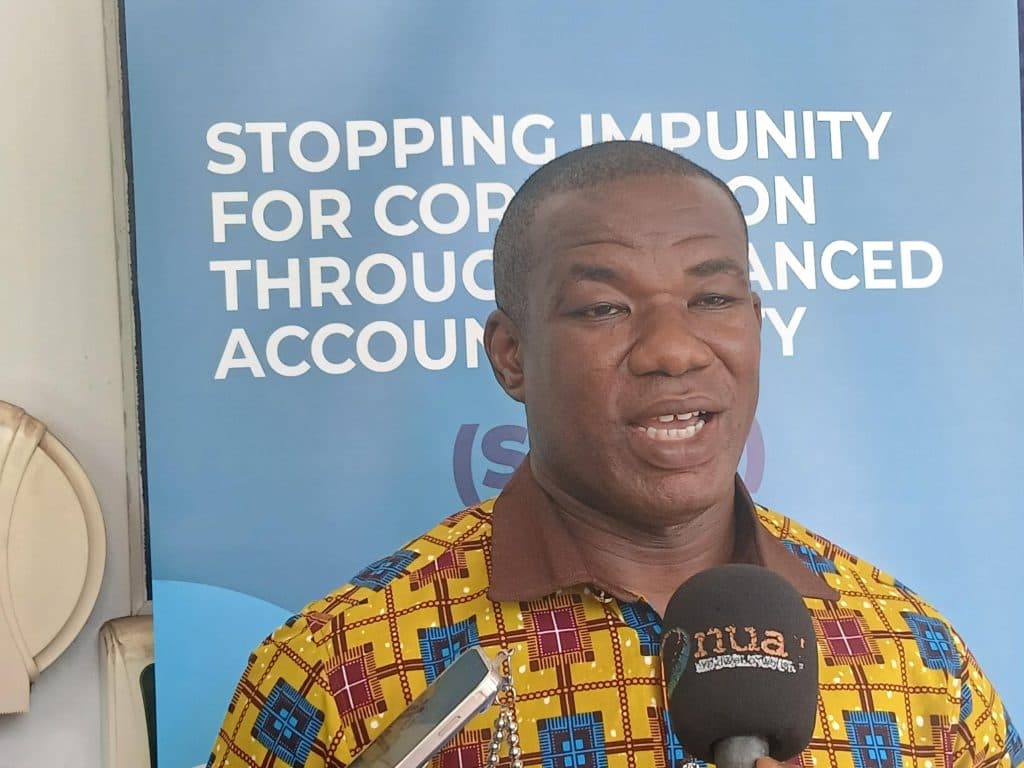
The Right to Information Commission says misinformation, disinformation and malinformation have become some of the biggest challenges to the effective exercise of the right to information in Ghana.
Head of Legal at the Commission, Stephen Owusu, said the growing spread of false and misleading information, particularly on digital platforms, makes access to credible information increasingly important.
Speaking on Good Afternoon Ghana on Metro TV on Thursday, September 3, 2026, Mr Owusu said the Commission’s 2026 Right to Information Month will focus on the issue under the theme, “Upholding information integrity in the digital age, the role of access to information in addressing information disorder.”
According to him, the theme is linked to the United Nations’ International Day for Universal Access to Information, observed on September 28 every year.
“As you say, our biggest challenge now to freedom of information, access to information, is misinformation, disinformation, malinformation.”
He said the Commission wants to use the month-long activities to bring key stakeholders together to discuss how access to reliable information can help address the problem.
“What we seek to achieve is to bring stakeholders to the table for us to discuss this issue,” he said.
Mr Owusu also used the interview to explain how Ghanaians can make requests for information under the Right to Information Act, 2019 (Act 989).
He said the process is relatively simple, with applicants able to make requests either in writing or orally.
For written applications, he said applicants must clearly describe the information they are seeking, state how they want to receive it, provide their name and address, attach an accepted form of identification and sign or thumbprint the application.
Mr Owusu stressed that applicants should not be forced to provide only the Ghana Card as identification.
“Anything that is nationally accepted as a means of identifying a person, it’s not only the Ghana Card,” he noted.
He said a passport or driver’s licence can also be used as identification.
The RTI Commission legal head further explained that people who cannot make written applications because of disability or illiteracy can make their requests orally through an information officer at the relevant public institution.
Under the process, he said, the information officer is required to reduce the oral request into writing, read and explain it to the applicant in a language they understand, and allow the applicant to sign, thumbprint or make a mark.
For applicants who are unable to read or write, Mr Owusu said the process must also comply with the Illiterate Protection Act of 1912, including the involvement of a witness.
Institutions have 14 days to respond
Mr Owusu said public institutions have 14 days to decide on an RTI application and communicate their decision to the applicant.
Where an applicant is dissatisfied with the decision, the person has 30 days to seek an internal review by the head of the institution.
He said the head of the institution then has 15 days to respond after receiving the application for review.
If the head fails to respond, the law treats the silence as an affirmation of the information officer’s decision to deny the request.
Mr Owusu also disclosed that the Commission received 99 applications for review in 2025, of which 57 were settled, largely through mediation.
He explained that some disputes arise from misunderstandings or the volume of information being requested, making mediation a faster way of resolving the issues.
Commission fines 254 institutions
The Commission has also imposed fines on 254 public institutions for failing to submit their annual RTI reports as required by law.
Mr Owusu said public institutions are required to submit their reports within 60 days after December 31 each year, allowing the Commission to compile its annual report for Parliament.
He said the Commission repeatedly reminded institutions about the requirement but had to impose the fines after a significant number failed to comply.
“And yes, as many as 254 institutions did not submit their annual report, and so we had to take that stringent decision.”
He rejected suggestions that the Commission was being unnecessarily difficult with public institutions.
“So it’s not as though we are troublesome. No, no. That’s what they’re supposed to do.”
Mr Owusu said the Commission is also working to extend its presence beyond Accra, with offices already operating in Kumasi, Sunyani and Bolgatanga.
He added that arrangements were being made to establish offices in other regions, including the Eastern, Northern, Western and Volta regions, but said funding remained a challenge.
“What is left is the money to go and work on those offices so that we can spread to those areas.”
Despite the resource constraints, he said the Commission was doing its best to fulfil its mandate.
“We do not have all the resources we need to work. Of course, as I said, we are a public institution. So we cannot possibly have everything we need to work. But we’ve been doing everything possible within the resources we have at our disposal to deliver on our obligation under the Right to Information Act.”