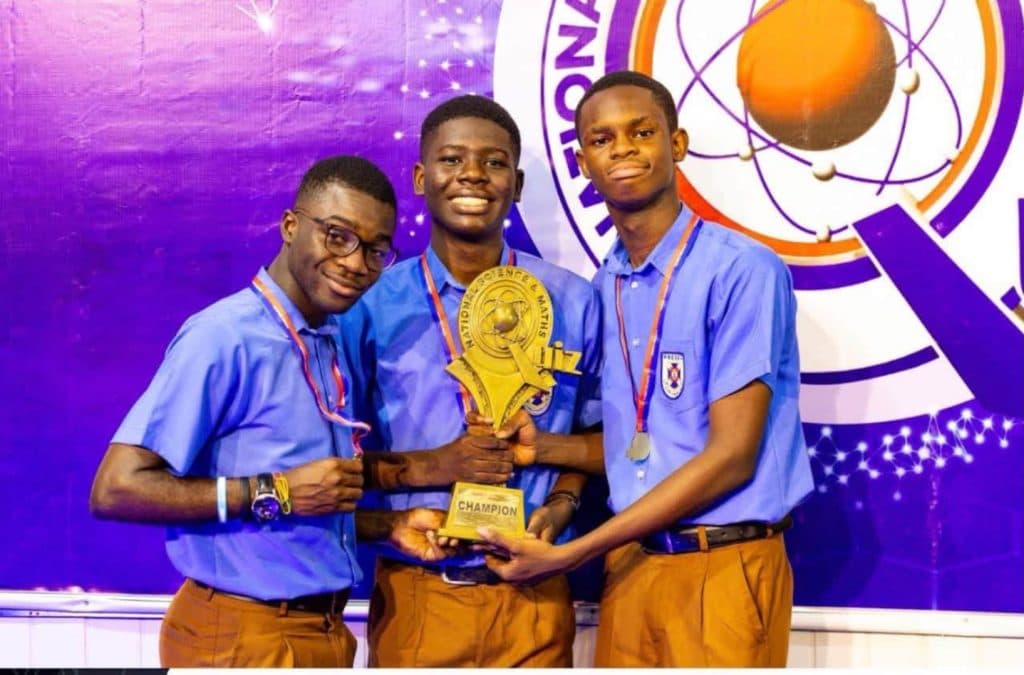
There are things that always bring Ghanaians together. One is football, language and another is our support for our secondary schools through the National Science and Maths Quiz.
NSMQ is not just a competition in Ghana; it is a shared experience and a passion. Whether in homes, WhatsApp groups, lecture halls or workplaces, the quiz has a unique power to unite people in ways few other things can.
Institutions, schools, churches and other organisations often come together to organise “Rep Your School” days, creating opportunities for people to reconnect with their alma mater and with one another.
I once walked into a bank during one of these “Rep Your School” days and met a bank teller who had attended the same school as me. We immediately bonded over our shared school experience.
A person may support one political party while another supports a different one. They may come from different regions or belong to different ethnic groups. But when it is time for NSMQ, these differences often disappear. For a few hours, school colours and school pride take centre stage.
Perhaps that is one of the reasons why the NSMQ has become more than an academic competition. It has become a cultural phenomenon.
The History and Evolution of NSMQ
But the culture of NSMQ today did not emerge overnight.It is the result of more than three decades of competition,personalities,rivalries and memorable performnaces.
Since its inception in 1993, the National Science and Maths Quiz has grown from a television quiz competition into one of Ghana’s biggest intellectual and cultural events.
When the quiz began ,it involved only 32 senior high schools across the country and Prempeh College won its maiden edition in 1994.
The quiz was originally sponsored by Unilever through its “Brilliant soap” brand and was popularly referred to as “Brilla” by many. In 1998,the tournament officially became known as the National Science and Maths Quiz.
The first quiz mistress was the late Professor Mariam Ewurama Addy,a professor of biochemistry at the University of Ghana,Legon.She was the quiz mistress from 1993 till 2000.
Professor Eureka Emefa Ahadjie Adomako, a botanist at the University Of Ghana,Legon took over as quizmistress from 2001 to 2005. She is currently a senior lecturer at the Department of Plant amd Environmental Biology at the University of Ghana.
In 2006, Prof Elsie Effah Kaufman,the founding Head of the Biomedical Engineering Department at University Of Ghana,Legon,took over as quiz mistress. She has since become one of the most recognisable figures associate with the NSMQ
Since its inception,only 11 schools have won the competition. Presbyterian Boys’ Secondary School has emerged as the most successful school in the quiz so far with Mfantsipim School being the second.
Achimota School remains the only coeducational schoool to have won the competition in 2004.
Creativity at Its Peak
One aspect of NSMQ that is often overlooked is the creativity behind the various school taglines and mantras.
Every year, schools and their supporters find clever ways to play with numbers and words, often incorporating the number of times their school has won the competition or reached the grand finale.
For example:
- Presec’s seventh championship: “We are 7, a Living God.”
- Presec’s eighth championship: “Our God is the Great8.”
- Presec’s ninth championship: “We are 7, the Gr8 Ado9.”
- Prempeh College’s fifth championship: “We glori5 Your Name.”
- Keta Senior High Technical School’s first championship: “1der Working God.”
It seems every year comes with a new and interesting mantra. These slogans demonstrate that NSMQ is not only a battle of intellectual ability but also a battle of creativity, wordplay and school identity.
Even first-time finalists and less established schools are not left out. Their supporters also find creative ways to celebrate their achievements and build excitement around the competition.
The Powerhouses
NSMQ is not necessarily an equal playing field.
Have you ever stopped to ask why Presec-Legon has been so successful in the competition while some schools struggle to progress beyond the early stages, let alone reach the grand finale?
What makes the established powerhouses different?
Let us focus our lenses on Presbyterian Boys’ Secondary School (PRESEC-Legon), one of Ghana’s prominent Category A schools and the most successful team in NSMQ history.
From its first victory in 1995 to its successive victories in recent years, PRESEC has established itself as a dominant force in the competition.
One major factor is the strength of its alumni network. PRESEC has a large and active alumni body that continues to support the school in various ways. The school also attracts some of the country’s strongest students, many of whom enter through the Basic Education Certificate Examination (BECE).
Another important factor is preparation. The teachers and coaches who train NSMQ contestants are often highly experienced. Some have coached previous contestants and therefore understand the demands, pressure and strategies required to compete at the highest level.
Infrastructure may also play a role. It cannot be ignored that schools that consistently perform well often have access to strong academic resources and learning environments. Well-equipped science laboratories, libraries, experienced teachers and other educational resources can provide students with an advantage.
But perhaps the most important question is this: Is success in NSMQ simply about having brilliant students, or does the system surrounding those students make the difference?
The Gender Factor
Another question that deserves attention is: Why has no girls’ school won the NSMQ championship?
This becomes even more interesting when we consider that the quiz has had female leadership at its helm, including the current quiz mistress, Professor Elsie Effah Kaufman.
So far, only two girls’ schools have reached the NSMQ grand finale.
In 1999, Wesley Girls’ High School reached the final and lost to Mfantsipim School, finishing as first runner-up. The team included Dr Yehoda Martei, Sharon Owusu-Darko and Denise Twum.
In 2013, Mfantsiman Girls’ Senior High School became the second girls’ school to reach the grand finale, with Grace Adoley Ansah and Adwoa Serwaa Adunyaa representing the school.
There have also been outstanding female contestants who have demonstrated that girls have the intellectual ability to compete at the highest level.
Francisca Lamini of Keta Senior High Technical School, for instance, was adjudged the Best Female Contestant in 2021. Francisca Lamini was part of his school’s team that qualified to the final in 2021 but couldn’t win the trophy.
Another notable contestant is Zuwera Mohammed of Tamale Senior High School, who competed in 2017 and later pursued medicine at the University of Cape Coast.
In an interview on the Delay Show in 2022, Professor Elsie Effah Kaufman discussed the absence of a girls’ school from the winners’ list and attributed the situation, among other factors, to confidence and preparation.
There is an interesting irony here. Professor Kaufman’s alma mater,Aburi girls has also struggled to make a deep run in the competition, despite its long history and academic reputation.
This raises an important question: What exactly is holding girls’ schools back?
Could it be the level of preparation? Confidence? Resources? The structure of training? Or perhaps the pressure and expectations surrounding the competition?
Would a separate competition create more opporunities for girls?. But would that solve the problem, or would it simply separate talented students who should be competing together?
The bigger issue is not whether girls have the potential. They clearly do. The question is how that potential can be translated into consistent success at the highest level of NSMQ.
The Great Minds of NSMQ
Above everything else, NSMQ has produced some exceptionally brilliant students.
The competition has given Ghana memorable contestants who have demonstrated remarkable speed, accuracy, confidence and depth of knowledge.
Among them are students such as Steven Kofi Ampem-Baah, who competed from form 1 to form 3 , and Dr Paul Azunre of Opoku Ware Senior High School , who in 2002 helped lead his school to an impressive 101 points in a single contest.
These contestants remind us that NSMQ is not simply about memorising formulas and theories. It demands critical thinking, teamwork, confidence, speed and the ability to perform under immense pressure.
When Rivalry Becomes Predictable
NSMQ thrives on healthy school rivalry. The excitement of seeing schools compete against one another is part of what makes the competition special.
However, it can become less exciting when the same few schools dominate year after year.
For the past several years, schools such as PRESEC-Legon and Mfantsipim have remained among the most dominant forces in the competition.
This raises an uncomfortable question: What are these schools doing differently?
Are they benefiting from stronger alumni support? Better resources? More experienced coaches? Stronger recruitment? Better preparation? Or is it simply a culture of excellence that has been built over several generations?
Whatever the explanation, repeated dominance can affect how other schools and their supporters perceive the competition. Some may begin to feel that winning NSMQ is almost predetermined.
Imagine a relatively inexperienced school coming up against one of the established giants in the competition. Does the reputation of the powerhouse affect the confidence of the opposing contestants before the contest even begins?
Could there be a psychological effect?
The New Challengers
Despite the dominance of the established powerhouses, new challengers continue to emerge.
Ghana Secondary Technical School (GSTS), for example, has shown that it can compete for the ultimate prize.
Keta Senior High Technical School also made history by reaching the grand finale in 2021. Bright SHS made history in the 2026 NSMQ by becoming the first ever private institution to reach the semi finals and secure a seeded spot. These are just a few schools have made history of the past years. In 2026, Accra Academy, for the first time made it to the grand finale.
Their emergence is important because it shows that the competition is not completely closed to new contenders.
The challenge, however, is whether these schools can build the same structures that have sustained the traditional powerhouses: strong coaching systems, consistent academic preparation and alumni support.
The 2026 Grande Finale
The 2026 Grande Finale was held on September 10 2026 with Presec-Legon,St. Augustine’s College(AUGUSCO) and Accra Academy.
PRESEC won with 40 points, Accra Academy finished with 33, and AUGUSCO with 27, giving PRESEC its ninth NSMQ title.
Yes, a new school madeit to the final. But an established powerhouse still lifted the trophy.
The Bigger Question
Perhaps the biggest question is this:
Can we ever get to a point where all three schools in the NSMQ grand finale are relatively unknown schools?
Can schools that have never reached the final suddenly rise to the top and compete for the trophy?
Are their alumni bodies strong enough to support them? Do they have the resources, coaching structures and academic environments required to compete against the established giants?
And perhaps the most intriguing question of all:
Can we ever see three girls’ schools competing against each other in the NSMQ grand finale?
The 2026 appearance by Accra Academy proved that the door to the NSMQ grand finale is not completely closed to new challengers. With PRESEC once again emerging as champions, then another question is raised, can a new contender not only challenge the giants but finally take the trophy from their hands?
NSMQ brings together people who may disagree on almost everything else but find common ground when their school steps onto the NSMQ stage.
That is the magic of the National Science and Maths Quiz.
And Perhaps the future of NSMQ should not only be measured by who wins the trophy, but by how many schools believe they have a genuine chance of lifting it.
Writer: Naa Amarley Amarteifio || UG