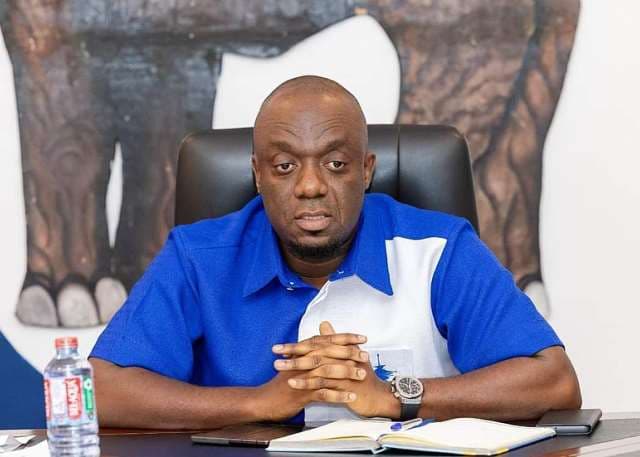
The Director General of the National Communications Authority, Rev Ing. Edmund Y. Fianko, says the authority’s responsibilities extend far beyond the regulation of basic telecommunications services.
Speaking in an interview with Moro Awudu on Good Morning Ghana on Metro TV as part of activities marking the regulator’s 30th anniversary, he said the NCA also oversees a wide range of radio communications services across several sectors.
According to him, the authority regulates aeronautical radio services, meaning every aircraft registered in Ghana must obtain a radio licence. Shipping vessels registered under the country’s call sign are also required to be licensed, along with users of two way radio systems such as security companies and broadcasters.
Rev Ing. Fianko explained that before the establishment of the NCA, spectrum management in the country was handled by the Ghana Frequency and Spectrum Allocation Authority, which also administered the national numbering plan.
He noted that the regulation of broadcasting itself became the subject of a major constitutional dispute in the early 1990s. In 1993, a private radio station known as Radio Eye began transmitting in protest against licensing requirements for media operators.
The move triggered a legal debate over Chapter 12 of the 1992 Constitution of Ghana, which states that no person should require a licence to operate a mass media outlet. However, the constitution also allows restrictions in the interest of public order, safety and national security.
The station’s operators were arrested and the case went to court. In 1996, the court ruled that although media freedom is protected under the constitution, the radio spectrum remains a public resource that must be regulated.
Rev Ing. Fianko said the ruling paved the way for legislation establishing the NCA. Parliament had initially passed the bill in 1994, but it was not immediately assented to by the president because the broadcasting regulation case was still before the courts.
After the court decision, the bill was reintroduced and eventually signed into law in December 1996.
By 1997, the NCA had been formally created under the supervision of the Ministry of Communications. At the time, the sector minister was Ekwow Spio-Garbrah.
The authority became fully operational in 1998 when the communications minister was John Dramani Mahama, who also served as the first board chairman of the regulator.
More than three decades on, Rev Ing. Fianko said the institution continues to evolve as the communications landscape expands. While licensing has become relatively easier for media organisations, he noted that the rapid growth in broadcasters and media outlets has also intensified competition within the industry.
According to the NCA, the surge in operators has placed pressure on the sector as many organisations compete for limited advertising revenue and audiences.
The authority says its role is to maintain order in the communications sector while ensuring fair access to spectrum and balancing the interests of industry players.
Three decades on, NCA’s work extends beyond telecoms
By Edward AcquahPublished
Image unavailable
Share this article
Social sharing is not yet available.