
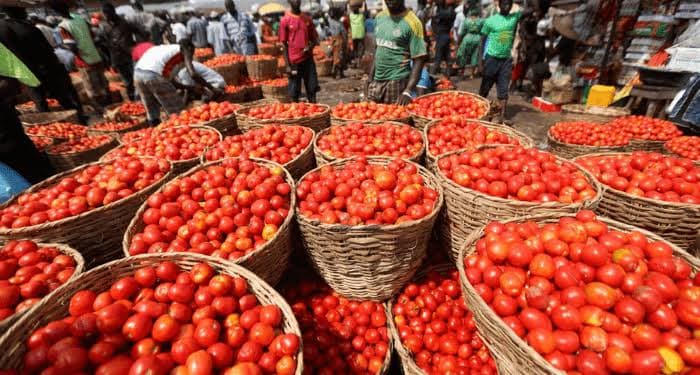
President of the Peanut Farmers Association of Ghana, Wepia Awal Adugwala, has renewed calls for government to invest in irrigation and transport infrastructure to help Ghana produce enough tomatoes and reduce dependence on imports from Burkina Faso.
Speaking on Good Afternoon Ghana on Metro TV, Mr Adugwala said the country has the capacity to meet its own tomato needs if the right policies and investments are put in place.
He explained that rising insecurity along the Ghana-Burkina Faso corridor has affected the movement of traders and pushed up tomato prices on local markets.
“For us as farmers in Ghana, we produce and then women and other traders come to buy the tomatoes,” he said.
“But as for Ghanaian traders moving to Burkina Faso to buy tomatoes, it has been there for a very long time.”
According to him, this situation is unnecessary.
“There is no need for Ghanaian traders to cross the border and risk their lives to buy tomatoes and come and sell in this country,” he added.
Mr Adugwala said one major problem is not production, but getting tomatoes from farms to markets.
“We even have tomatoes in certain rural areas getting rotten on farms,” he revealed.
“The issue is that we are not able to transport the tomatoes to the market centres.”
He stressed that bad road networks and weak transport systems continue to limit farmers’ access to consumers.
“Infrastructure is very key to us. We have to look at the road network, bringing farming communities to the market centres,” he said.
The farmers’ leader also warned that depending on rainfall is no longer sustainable.
“We can no longer depend on rain-fed agriculture in the era of climate change,” he noted. “What we need is key irrigation.”
He described the proposed Pwalugu Multipurpose Dam as critical, especially in managing water flows from upstream, and supporting large-scale vegetable farming.
“When the Bagri Dam spills in Burkina Faso, the water comes into Ghana and damages farms and houses,” he said.
“All that water can be collected into the dam and used for cultivation.”
He also referred to the government’s “Irrigation for Wealth” initiative and urged authorities to take it seriously.
“If government takes that project seriously, then as farmers, we are ever ready to engage in cultivation,” he said.
Mr Adugwala also addressed concerns that consumers prefer tomatoes from Burkina Faso.
He blamed this partly on weak investment in agricultural research.
“If the varieties they are growing in Burkina Faso are doing well, they can also do well here,” he said. “The question is, have we invested in research?”
He called on research institutions, including the Kwame Nkrumah University of Science and Technology (KNUST), to work with government to develop suitable varieties for local conditions.
“Our soil scientists and researchers must come on board,” he said. “Soil testing has to take place.”
He cited the example of Senegal, which developed its own wheat varieties during the COVID-19 period with support from research institutions.
“That shows that when research is empowered, new varieties can be developed,” he said, referring to discussions at an African Union food summit he attended.
Mr Adugwala said farmer groups have been engaging the Ministry of Food and Agriculture and have received some support.
He mentioned that irrigation pumps seized from illegal mining activities had recently been allocated to farmers.
“These are some of the things we want to see,” he said.
However, he stressed that more needs to be done, especially in building and rehabilitating irrigation facilities.
“Government must look for funding to construct the KwaLugu multipurpose dam,” he said. “It will be of great importance to vegetable farmers.”



