
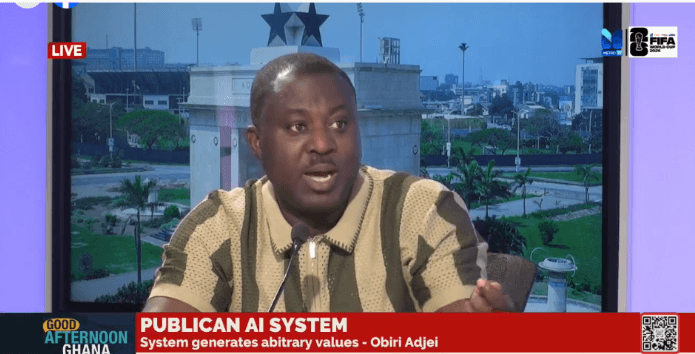
Chairman of the Concerned Freight Forwarders and Traders Association, Oheneba Kwasi Afawuah, says the situation at Ghana’s ports has worsened in recent weeks, with import duties rising sharply under a new AI-driven system.
Speaking on Good Afternoon Ghana on Metro TV on Thursday, April 9, 2026, Oheneba Kwasi Afawuah painted a grim picture of operations at the ports, saying traders are now dealing with arbitrary valuations that are making it difficult to clear goods.
“It’s worse at the port now,” he said. “Our port of entry… they start to give you arbitrary values. That kills.”
According to him, the changes have had an immediate impact on the cost of doing business, warning that consumers will ultimately bear the burden.
“For the past two weeks, it has been a very hectic time for us… your normal duty that has been paying now has now been quadrupled,” he said.
“What it means is that the thing gets to markets and market people are also going to add their costs and their profit… and the final consumers are going to be the people who are going to suffer.”
Mr Afawuah said although the AI system was introduced to support existing platforms like ICUMS and improve efficiency, the reality on the ground suggests otherwise.
“All the successive governments come and introduce a new system… all in the name of facilitating trade at the port. But it doesn’t happen,” he said.
“When they are bringing this AI, the whole story is to facilitate the process… but we have seen that it’s not going to be like that.”
He argued that instead of easing processes, the system appears to be focused on increasing state revenue, often at the expense of traders.
“It’s all going to be like getting more revenue for the state, which we are not against… but the model that is happening now, that’s what we are against,” he explained.
The association says the high duties are leaving many importers unable to clear their goods, leading to congestion at the ports.
“Goods are stuck at the port. People are not able to pay,” he said, adding that official data on revenue gains may not reflect the actual challenges on the ground. “Get to the field and see if people are paying duty or not.”
To illustrate the scale of the increases, Mr Afawuah cited specific examples. A 20-foot container of microwaves, he said, now attracts a duty of GH¢166,000, up from about GH¢60,000 previously.
“Divide the quantity by the duty… one microwave is about GH¢750 duty. How much is it being sold in the market?” he questioned.
He also pointed to a consignment of slippers, where importers are being charged nearly GH¢500,000 in duties, and air conditioner outdoor units, where 250 units attract GH¢286,000.
“Only the outdoor unit… and the duty is GH¢286,000,” he said. “In effect, one outdoor unit, the duty on it is GH¢1,271.”
Mr Afawuah further criticised the dispute resolution process, saying petitions submitted through the customs portal are often rejected without proper consideration.
“They are telling you to send the petition… for them to decide whether it should be reviewed or not. And as I’m speaking, they will come back with a report that it has been declined,” he said.
He also raised concerns about the system rejecting legitimate trade documentation, including shipments from India backed by recognised customs valuation systems.
“The AI is rejecting shipment from India… that gives the true reflection of the transaction. AI is rejecting it and nothing has been done about it,” he added.
The association is calling for urgent dialogue with authorities to address the challenges.
“We are saying, let’s sit at the round table… all the problems that we have identified, we’ve tabled it one by one,” he said.
“Let’s sit down and see how effective we are going to run the system.”
He warned that if the issues are not resolved, business activity at the ports could grind to a halt, with wider implications for the economy.



