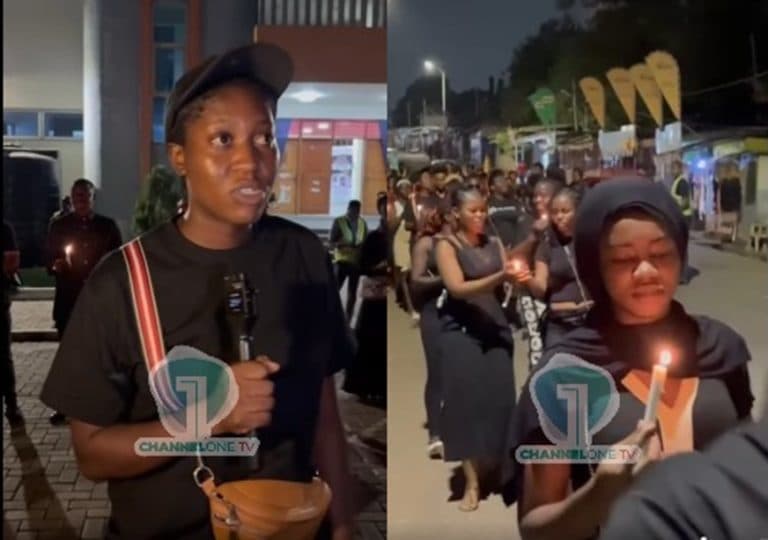
Students of the University of Media, Arts and Communication, UniMAC-IJ, have held a candlelight vigil in memory of Nelson Blay Nokotey, a journalism student whose life was cut short after he was knocked down by an unregistered vehicle near the Dzorwulu traffic light intersection in Accra.
The vigil, held on Friday, January 23, brought together grieving students, lecturers and friends who described Nelson as quiet, committed and full of promise.
Candles were lit and prayers said as students called for urgent safety measures, particularly the construction of a footbridge along the busy N1 Highway near the South Legon campus.
Nelson Blay Nokotey died on Tuesday afternoon after he was struck while attempting to cross the road close to the traffic lights near the footbridge leading towards the Achimota Forest. University records and eyewitness accounts indicate that he had earlier visited campus and was on his way home when the incident occurred between 4:00 p.m. and 6:00 p.m.
Verified information from the University’s Head of Security, the Ghana Police Service, eyewitnesses and Nelson’s family shows that the driver initially stopped and pretended to offer assistance. The driver, however, later abandoned him at the scene. His body was later discovered by a police patrol team in the Korle Bu area.
University authorities clarified the circumstances surrounding the incident after conflicting reports circulated on social media and in earlier publications. UniMAC management and student leaders say the accurate account was established following engagements with security officials and the police.
The SRC president elect, Moses Desire Kouyo, and the Coordinating Committee Chairperson, Mrs Clarissa Bandoh Amoako, met with university management on Wednesday to confirm the facts. The meeting was attended by the Vice Chancellor, Professor Eric Opoku Mensah, the Pro Vice Chancellor, Professor Abroampa, the Registrar, Dr Oforiwaa, the Dean of Students, Dr Ike Tandoh, the Head of Security, Mr Ohene, the Director of Academic Affairs, Mr Felix Botah, representatives of the Justice for Nelson initiative and student leaders.
Student leaders also raised concerns about communication gaps and fee-related challenges that had led to Nelson’s visit to campus. Academic Affairs assured students that measures would be taken to improve clarity and timely communication.
The family of the deceased has since met separately with university management and is currently completing arrangements regarding the body. They thanked the university for its support during the difficult period, while students were urged to show restraint and compassion in public commentary as the family mourns.
During the vigil, students renewed calls for a footbridge at +233 Place near Dzorwulu junction, which they say has become a death trap.
Speaking on behalf of UniMAC students, Helen Porsoo appealed directly to the Member of Parliament for Ayawaso West Wuogon, John Setor Dumelo, to push for urgent safety interventions to protect students who cross the highway daily.
University management clarified that the construction of a footbridge does not fall under the direct responsibility of the institution, but rather government agencies, local authorities and the area Member of Parliament. Student leaders say advocacy efforts will now be directed at those bodies.
Beyond mourning Nelson, students say his death stresses a long-standing danger at the +335 Junction at North Dzorwulu, where accidents are frequent, many involving students heading to lectures. Several students told Metro TV that crossing the road feels like a gamble, particularly during peak traffic hours, describing the daily journey as a life-threatening risk.
The student body is calling for swift intervention from the Roads and Highways Ministry, the Education Ministry and the area Member of Parliament. They warn that if immediate action is not taken, students may resort to protests and formal petitions to press for the construction of a footbridge to prevent further loss of life.
As candles burned low on campus, students said Nelson Blay Nokotey should be remembered not only for how he died, but for the urgent change his death must bring.