
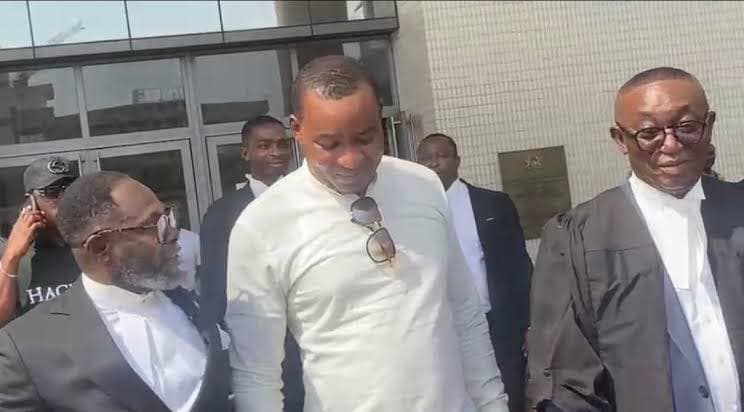
Following the arrest of Bernard Antwi Boasiako, popularly known as Chairman Wontumi, several eyebrows have been raised while some questioned the cause of his arrest.
The prosecution’s case started from an anti-galamsey operation in the Western Region on April 17, 2025, where the police arrested Michael Gyedu Ayisi and 28 others in the Samreboi Forest, within and around Akonta Mining’s concession.
For public notice, Chairman Wontumi was not jailed simply because of illegal mining occurred on a concession linked to Akonta Mining Company Limited. He was jailed because the High Court concluded that he was the controlling mind behind the company, that he permitted third parties to enter the company’s Samreboi concession, an arrangement that amounted to an unlawful dealing with mineral rights and the purposeful facilitation of unlicensed mining.
That is the central point in the 59-page judgment delivered on July 20, 2026, by Justice Audrey Kocuvie-Tay of the High Court, Criminal Court 4, in Accra.
The case was brought against Bernard Antwi Boasiako, Kwame Antwi, who remained at large, and Akonta Mining Company Limited.
Wontumi, who pleaded not guilty on his own behalf, and on behalf of the company.
The judgment answers a question that has dominated public discussion:
” why was Wontumi jailed”?
The answer is not political rhetoric.
It lies in two findings of law and fact.
First, the court found him guilty of assignment or dealing with mineral rights without prior written ministerial approval.
Second, it found him guilty of purposely facilitating an unlicensed mining operation.
At the time of arrest, the group was occupying a structure with Akonta Mining’s name boldly written on it where the Police retrieved eight pump-action guns, one single-barrelled gun, five pieces of metal suspected to be gold, four machetes, water-pumping machines, 310 AAA/BB cartridges, a grease gun, four motorcycles, two vehicles, 25 serviceable excavators, four non-serviceable excavators and GH¢157,000.00.
These facts immediately turned the case from a simple dispute over land reclamation into a test of control, permission and responsibility.
Michael Gyedu Ayisi identified Henry Okum as his employer, saying Okum had assigned him to supervise mining activities. Henry Okum later told investigators that he had an arrangement with Wontumi under which he was allowed to enter Akonta Mining’s concession to mine for gold because he believed the concession belonged to Wontumi.
The prosecution said the mining and reclamation activities were carried out with Wontumi’s permission and without the required prior approval of the Minister responsible for Lands and Natural Resources.
The absence of ministerial approval became one of the least contested issues in the trial. The court recorded that mineral rights are transferable only with ministerial approval and that Akonta Mining had never applied for such approval in relation to the Samreboi and Abekoase land.
The main case was not whether written ministerial approval existed.
It did not.
The real question was whether Wontumi had merely allowed reclamation, as he claimed, or whether he had permitted mining under the cover of reclamation.
Story by By Martha Seyram Jackson || Metro Digital