
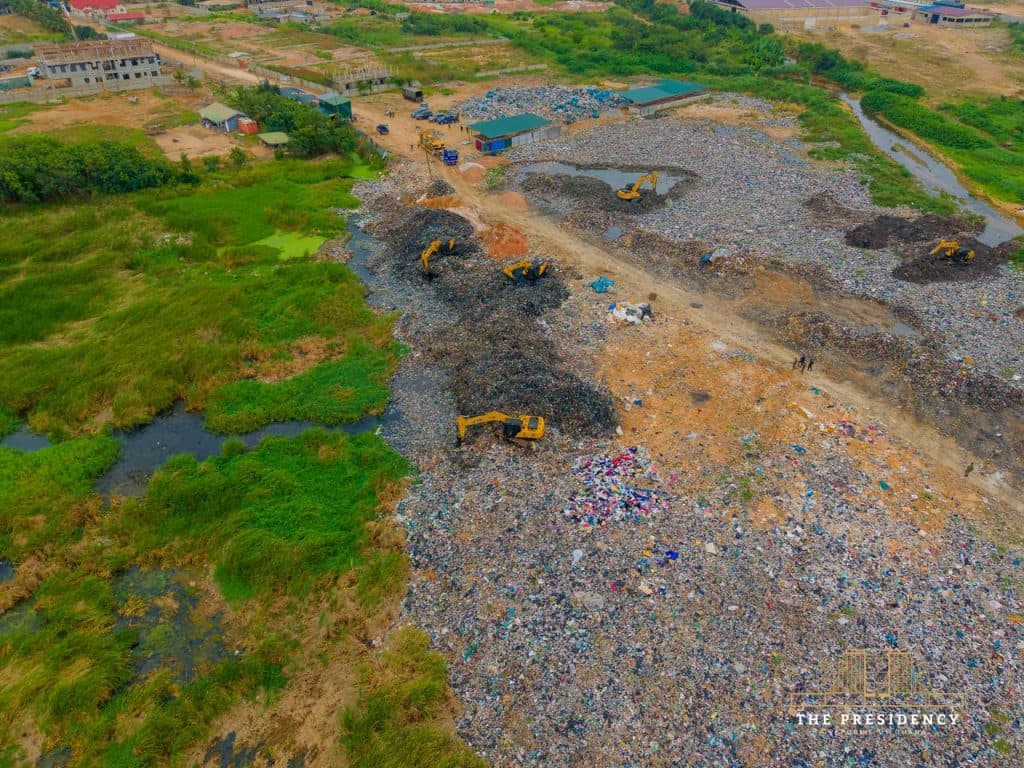
Work has begun to reclaim the Lafa water retention basin at Mallam as part of efforts to reduce the risk and impact of flooding in Mallam, Weija, Dansoman and other surrounding communities.
The exercise, being carried out by the 48 Engineer Regiment of the Ghana Armed Forces, seeks to remove years of accumulated solid waste, laterite and other materials that have significantly reduced the basin’s capacity to hold and discharge stormwater.
Heavy machinery is being used to break up and remove tonnes of compacted waste from the basin for transportation to a designated landfill site at Nsawam.
The operation also involves the demolition of illegal structures within the water reserve and the construction of protective embankments to prevent further encroachment.
The exercise is being coordinated by the Post-Flood Mitigation Task Force, headed by the Deputy Chief of Staff in charge of Operations, Stan Xoese Dogbe.
Head of Drainage at the Ghana Hydrological Authority, Ing. Richard Kofi Amekor, said the extent of solid waste dumped in the basin over the years has made the exercise particularly challenging.
He said the persistent flooding along the Mallam-Gbawe and Awoshie-Kasoa highway corridor, as well as parts of Dansoman, is partly attributable to the heavy silting of the Lafa Basin.
According to him, individuals had dumped solid waste, boulders and laterite into the basin and used the materials to reclaim portions of the land for development.
“The Lafa takes its source from Mallam-Gbawe Zero, and the water flows all the way through Santa Maria, Atieku, Pallas Town, Alhaji Tabora, McCarthy Hill into the basin before gradually being discharged into the sea,” he explained.
He said the heavy silting prevented rainwater from flowing into the basin during the torrential rains of June 29, resulting in backwater flooding in communities including Blue Lagoon and parts of Dansoman.
“The topography in this area with the hills upstream obviously pushes more water into this basin and the blockade causes the devastating floods. If this exercise is done, it will mitigate the floods that we do experience. It may not prevent it entirely but will significantly reduce the impact,” Ing. Amekor said.
He said successfully excavating the basin would help restore its natural capacity to accommodate large volumes of water during heavy downpours.
Ing. Amekor also called for the demolition of all illegal structures located within the basin to prevent a recurrence of the problem.
“Some buildings are within the basin, and they have reduced its capacity. All those illegal structures must go down,” he said.
He added that the Ghana Hydrological Authority would work with the Weija-Gbawe Municipal Assembly to secure the banks of the basin after the exercise.
Brigadier General Richard Kinney, Commander of the 14 Engineer Brigade of the Ghana Armed Forces, said the immediate priority is to loosen the compacted waste to make it easier to remove.
He explained that some of the waste had been capped with laterite and heavily compacted over the years as part of efforts to reclaim the land.
“The main work is dredging. We are trying to loosen the waste material dumped here for years, capped with laterite and compacted to secure part of the land for sale. Once we loosen, it will be easy to evacuate, and the haulage will be done at night to the final disposal site at Nsawam,” he said.
Brigadier General Kinney said the operation could take several months to complete and cautioned residents and other persons around the basin against further dumping or encroachment.
Meanwhile, Brigadier General Forster Okae-Yeboah, Director General of Joint Operations at the Ghana Armed Forces and Coordinator of the Flood Mitigation Works, said similar operations are ongoing in other parts of Accra.
He said work is currently underway at Oyarifa and East Legon, as well as around the Kpeshie Lagoon area.
He disclosed that the next phase of the exercise would begin around the Kpeshie enclave and Laboma Beach to open the channel into the sea.
“Our objective is to mitigate the impact of floods in Accra, and I urge the public to cooperate with the taskforce,” he said.
Brigadier General Okae-Yeboah said the government has made funds available for the flood mitigation programme and secured the equipment required for the works.
He, however, called for support from private sector actors to complement government’s efforts.
“I am happy to announce that the President honoured his pledge and money is available, we have equipment to undertake the assignment, but government cannot do it alone so we shall be grateful to welcome the private sector if they want to come on board,” he said.