Ghana has spent years playing catch-up with the rest of the world on climate issues. Attending meetings. Signing agreements. Coming home with promises.
But according to Ing. Glenn Kwabena Gyimah, it is time to flip the script.
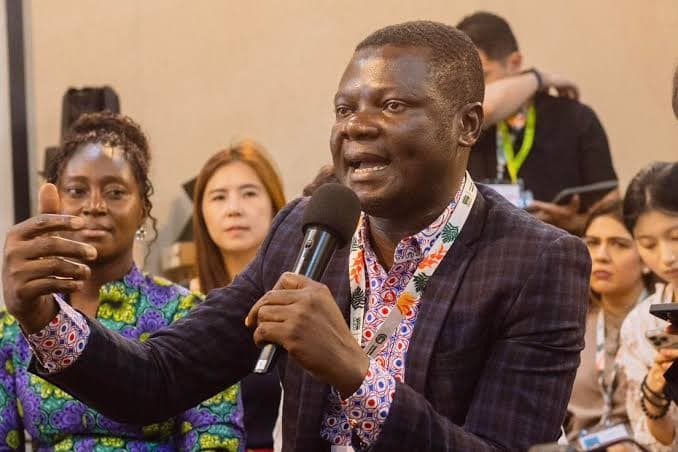
Speaking at the World Environment Day 2026 National and African Climate Dialogue on Metro TV, the Jospong Group’s Green Transition General Manager made a bold claim: Ghana has what it takes to lead the continent on circular economy. Not tomorrow. Now.
“Ghana has the innovation capacity, the entrepreneurial spirit, and the human capacity to lead this transformation,” he said. “Not only in Ghana, but in Africa.”
Not just attending meetings, writing the rules
Ing. Gyimah revealed something many Ghanaians may not know. He has been actively involved in global and national standards setting, including participation in ISO Technical Committee 323 on Circular Economy and Ghana’s National Mirror Committee.
He has also contributed to developing electric vehicle standards in Ghana.
That means, behind the scenes, Ghanaian experts are already at the table where the global rules are being written.
“How do we take the promises that have been made at various boardrooms and turn them into real breathing change in the streets of Accra, Kumasi, and Takoradi, and even beyond?” he asked.
His answer was not complicated. But it was ambitious.
From global commitments to local action
The theme of the dialogue was “Climate Action in Africa: From Global Commitments to Local Action.” Ing. Gyimah took that seriously.
He said too many international meetings end with beautiful communiqués that gather dust on shelves. The real work, he argued, happens when those commitments hit the ground.
“We must ask ourselves a very difficult question,” he said. “How do we turn all these things into a much more tangible and life-changing situation?”
His answer: circular economy, done the Ghanaian way.
What would leadership actually look like?
Ing. Gyimah did not just talk about leading Africa. He laid out what that would require.
First, policy and governance that forces extended producer responsibility, meaning companies take back what they produce.
Second, infrastructure and logistics for efficient collection and sorting.
Third, digital systems and AI to track waste, optimise routes, and strengthen reporting.
Fourth, financing that treats circular economy projects as investable, not risky.
And fifth, bringing informal waste pickers into the formal system.
“By so doing, we are able to drive towards a sustainable, inclusive growth and provide dignified livelihood to all,” he said.
The numbers are already there
He cited the 2026 ISSER study showing the waste sector could deliver up to US$47.9 billion in annual economic benefits by 2032.
That is not a small opportunity. That is a national transformation.
“Waste is no longer a sanitation issue,” he said. “It is increasingly recognised as a resource stream with economic value.”
He pointed to the Jospong Group’s own footprint across all 261 districts, with 16 plants already turning waste into compost, recycled plastics, road-building materials, and even fuel.
But he made it clear: one company cannot carry the whole country.
The international market is waiting
Ing. Gyimah noted that circular economy opens pathways to climate financing, carbon market participation, and international trade.
Ghana, he argued, is already part of the conversation. ISO committees. National mirror committees. EV standards. These are not small things.
“The secular economy has come to stay,” he said. “All of us must get on board to make the best out of it.”
The closing shot
Ing. Gyimah ended with a challenge that sounded almost like a dare.
“The question before us is not whether the circular economy is possible. The question is how quickly we are willing to make it a reality.”
He said Ghana has a choice.
“Continue with systems that waste our resources and limit our future. Or embrace a circular model that unlocks jobs, restores ecosystems, and strengthens national resilience.”
“Ghana has the opportunity,” he repeated, “not just to participate in the transition, but to lead it.”