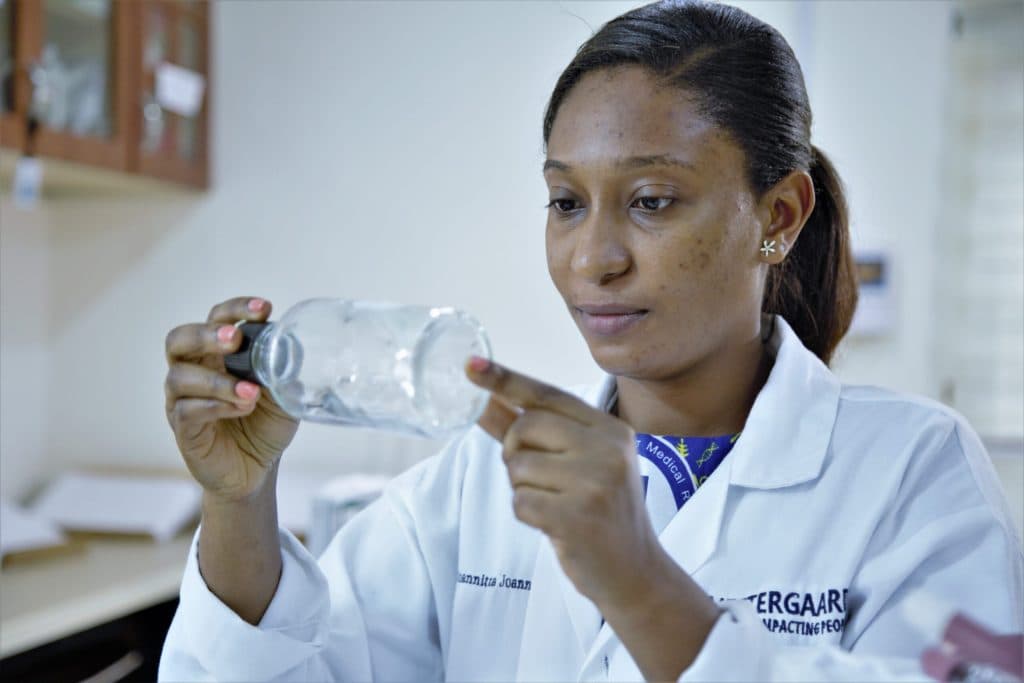
Inside a laboratory on the University of Ghana campus, Joannitta Joannides spends her working days doing something that sounds, on its face, counterintuitive: breeding mosquitoes.
As Laboratory Manager at the Vestergaard-Noguchi Vector Labs (VNVL), housed at the Noguchi Memorial Institute for Medical Research, Joannides maintains living colonies of the very insects responsible for spreading malaria across the African continent. It is not a contradiction. It is the point.
“You can’t outsmart an enemy you don’t understand,” is the logic that underpins her work. To keep the tools that protect African communities from malaria effective, scientists first need to understand how mosquitoes are changing — and that means studying them up close, generation after generation, under laboratory conditions.
The scale of the problem VNVL was built to address remains stark. Africa accounted for 94% of malaria cases and 95% of malaria deaths recorded globally in 2024, according to global health data. Insecticide-treated bed nets remain the single most important tool in the fight against the disease, credited with averting hundreds of millions of cases since they became widely available.
But that protection cannot be assumed to last. Mosquitoes evolve. Populations across the continent have developed resistance to the insecticides used in nets, and their behaviour — when and where they bite, which surfaces they rest on — continues to shift in response to the very tools designed to stop them. An intervention that works well in one region can quietly lose its edge in another as local mosquito populations adapt.
That is why the work happening inside VNVL matters far beyond the walls of the laboratory.
At VNVL, Joannides and her colleagues raise mosquito colonies specifically to test how they respond to the insecticides used in malaria prevention products. It is meticulous, unglamorous work: rearing insects through their life cycles, exposing them to treated materials under controlled conditions, and recording exactly how — and whether — they die.
The results feed directly into resistance monitoring and product evaluation, giving national malaria programmes and manufacturers the evidence they need to know whether a given net or spray is still doing its job, or whether mosquito populations in a particular area have started to outpace it.
“The fight against malaria does not stand still,” Joannides says, “and neither can the science.” As mosquitoes evolve and new vector-control tools come to market, the surveillance work never really ends.
This year marks 15 years since Vestergaard and the Noguchi Memorial Institute for Medical Research first began their partnership in Ghana. What started as a single laboratory has since grown into a broader centre of scientific expertise, with expanded testing capabilities, formal quality management systems, and — perhaps most significantly — a deepening base of local research capacity.
That local capacity has been central to the partnership’s approach. Rather than importing expertise from elsewhere, VNVL has invested in training Ghanaian scientists and technicians, equipping them with the skills to run rigorous, internationally recognised product evaluations from within the country most affected by the disease.
The partnership has also extended beyond the laboratory itself. Vestergaard’s collaboration with Ghana’s National Malaria Elimination Programme, reinforced through a tripartite memorandum of understanding renewed last year, reflects a wider effort to link scientific research directly to national malaria strategy — ensuring that what is learned in the lab translates into decisions made in the field.
World Mosquito Day, observed on 20 August, typically focuses attention on the mosquito as a disease vector — a public health threat to be understood and controlled. The story emerging from VNVL offers a different vantage point: one centred on the scientists, partnerships, and research infrastructure working quietly behind the scenes to keep malaria prevention effective.
It is a reminder that progress against malaria depends not only on the tools already in use, but on the ongoing science required to keep them working — and on the people, like Joannides, doing that work in laboratories across the continent.