
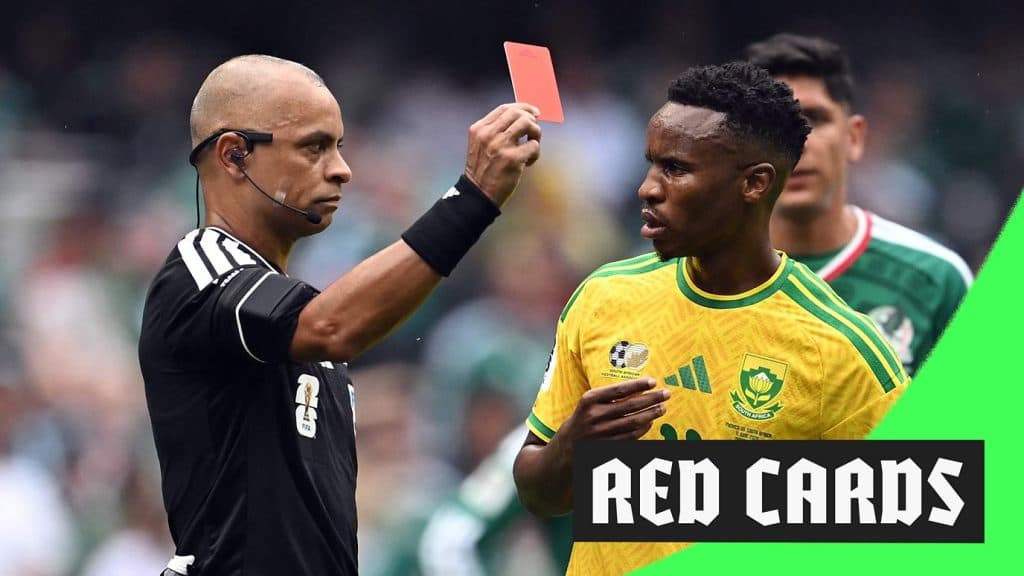
The 2026 World Cup opened with a surprise: three red cards in Mexico’s 2-0 win over South Africa. South Africa’s Yaya Sithole and Themba Zwane were sent off, while Mexico’s Cesar Montes saw red deep in stoppage time.
The number immediately stood out because the last two World Cups in Russia and Qatar produced only four red cards each in the entire tournament. Suddenly, after just one match, this World Cup is already close to matching that total.
It would be tempting to declare that referees have become much stricter, but the reality is more nuanced. FIFA’s refereeing department, led by Pierluigi Collina, has generally tried to keep players on the field unless a dismissal is clearly deserved. That approach contributed to the low red-card totals in 2018 and 2022. In the opener, Sithole’s red card for denying a clear goalscoring opportunity was widely viewed as straightforward. Zwane’s dismissal for violent conduct, however, was far more controversial and came after a VAR review, with many observers arguing the contact looked accidental rather than aggressive.
How the opener unfolded
| Incident | Decision | Why it mattered |
|---|---|---|
| Yaya Sithole foul on Brian Gutierrez | Red card | Denied a clear goalscoring opportunity (DOGSO) |
| Themba Zwane clash with Roberto Alvarado | Red card after VAR review | Assessed as violent conduct, but heavily debated |
| Cesar Montes late tackle | Red card | Referee judged it as DOGSO in stoppage time |
The key question is whether this match signals a trend or simply an outlier. The third red card, against Montes, initially looked harsh, but replay angles suggested the South African attacker was likely through on goal with little defensive cover. Recent interpretations of the DOGSO law have also evolved, allowing referees to consider the positions of other attackers as well as defenders. Taken together, the decisions were at least defensible, even if not universally accepted. One dramatic match does not prove that the tournament will become a festival of dismissals. For now, the safer conclusion is that the opener was unusual rather than evidence of a refereeing crackdown.
Takeaway
Why the concern feels bigger than the evidence
- The opener felt unusual because recent World Cups had very few redsRussia 2018 and Qatar 2022 each finished with only four red cards across the entire tournament.
- Two of the three dismissals can be defended under current interpretationsBoth DOGSO decisions were supportable based on the attacker’s path to goal and the lack of covering defenders.
- The Zwane red remains the biggest talking pointVAR intervened for violent conduct, but many viewers felt the replay evidence was not as clear-cut as the protocol ideally demands.
- One match is not enough to predict the whole tournamentAcross a 104-game competition, an early three-red game may end up looking more like a statistical anomaly than a new refereeing standard.
Bottom line: The opener was dramatic and controversial, but it is too early to say referees are suddenly handing out red cards like confetti.