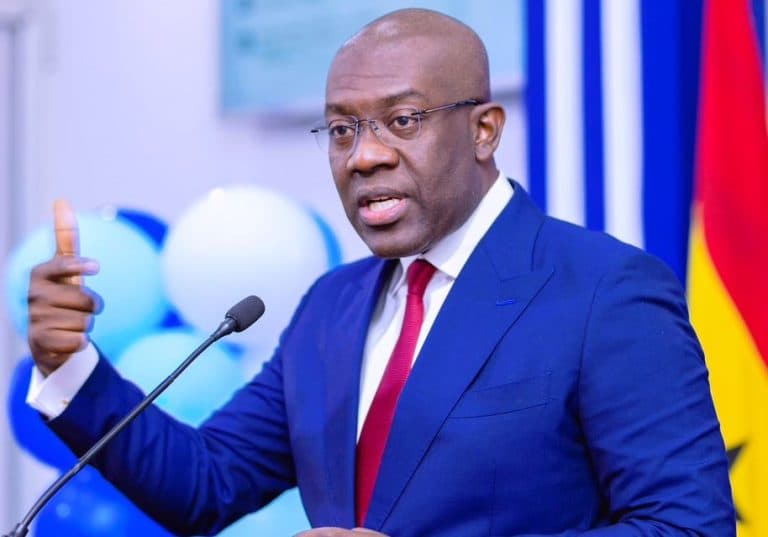
The Member of Parliament for Ofoase-Ayirebi, Kojo Oppong Nkrumah, has accused the government of failing to fully disclose the economic consequences of measures used to stabilise the cedi and control inflation, warning that taxpayers could eventually bear the cost of the interventions.
Speaking in an interview with Moro Awudu on Metro TV’s Good Morning Ghana on May 22, Oppong Nkrumah said recent gains in the economy should not distract from deeper structural challenges, including rising youth unemployment and the financial position of the Bank of Ghana.
He argued that the appreciation of the cedi began before the NDC administration took office, claiming the central bank later intensified foreign exchange interventions by injecting large amounts of dollars into the market to strengthen the local currency.
“What they were doing was pumping dollars into the economy beyond the normal equilibrium level,” he said.
According to the former Information Minister, the policy may have helped stabilise the cedi in the short term but came at a significant cost to the Bank of Ghana.
He alleged that government officials initially denied the scale of the interventions until the International Monetary Fund directed authorities to stop the practice and introduce a clearer framework.
Oppong Nkrumah said pressure on the cedi returned once the interventions slowed, forcing officials to later acknowledge publicly that the central bank had been supporting the currency through market operations.
The MP also criticised the Bank of Ghana’s use of sterilisation measures aimed at reducing inflation by absorbing excess liquidity from commercial banks.
He explained that banks were encouraged to deposit funds with the central bank instead of lending to businesses and consumers, reducing spending and demand in the economy.
While he acknowledged that the strategy may have helped slow inflation, he argued that government had failed to address underlying supply side pressures, including rising electricity and water tariffs, which continue to increase production costs for businesses.
Oppong Nkrumah claimed the combined impact of the interventions and sterilisation measures contributed to losses of about GH¢34.9 billion at the Bank of Ghana and left the central bank with negative equity estimated at about GH¢96 billion.
“What it means is that all of us will eventually pay for it,” he said, warning that taxpayers could face the burden through a future recapitalisation programme.
He also dismissed suggestions that Ghana’s programme with the International Monetary Fund had collapsed.
According to him, the country’s Extended Credit Facility programme ended successfully without renegotiation or suspension, unlike some previous IMF arrangements.
He said the government was now pursuing a new arrangement known as a Policy Coordination Instrument, which he described as a framework involving closer IMF oversight of economic policy.
Oppong Nkrumah called on the government to be transparent about the terms and implications of the arrangement before it is presented to Parliament.
He further cautioned against celebrating what he described as marginal economic improvements while broader challenges remain unresolved.
The MP identified youth unemployment, particularly in Greater Accra, as one of the country’s most urgent problems.
“If one out of every two young people in Greater Accra is unemployed, then those are the real issues we should be focusing on,” he said.
He also warned that Ghana remains vulnerable to global economic shocks, citing tensions in the Middle East and their impact on crude oil prices as a reminder that external developments could quickly undermine recent gains if structural weaknesses in the economy are not addressed.