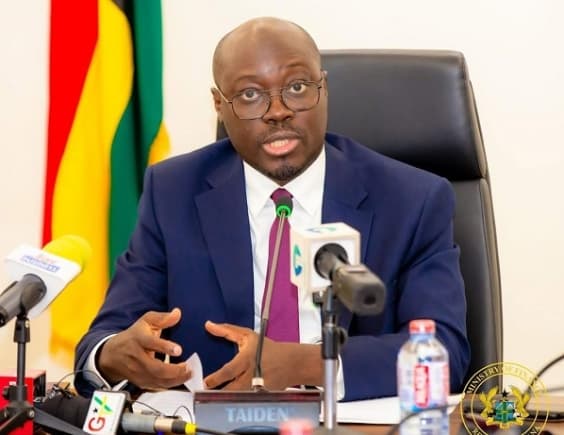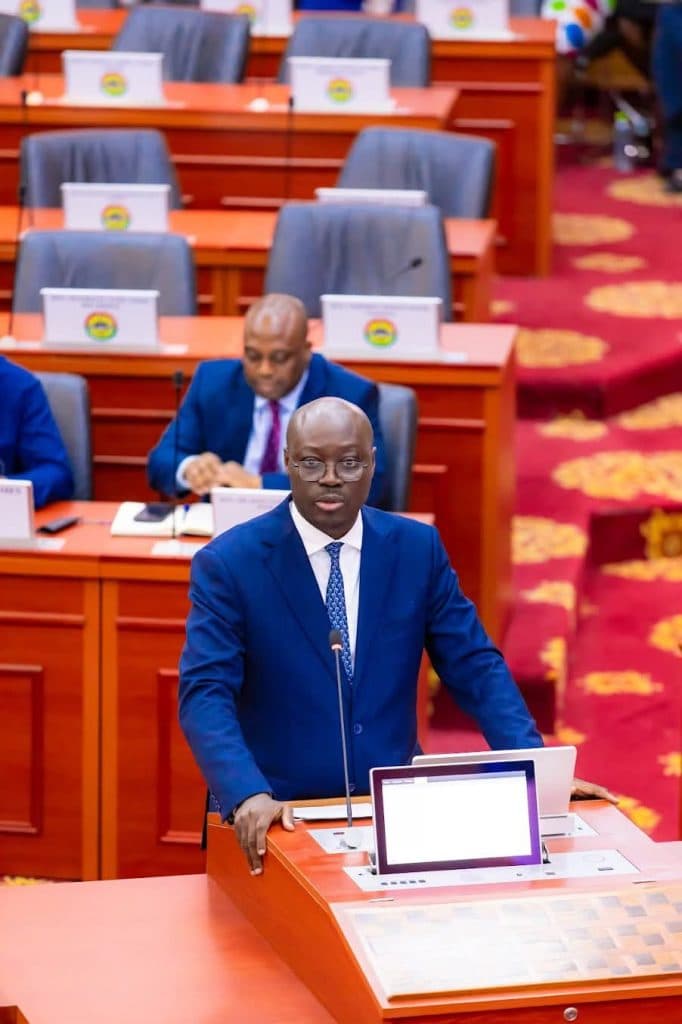
Finance Minister Dr Cassiel Ato Forson has announced that Ghana will transition from an IMF bailout programme to a non-financing reform arrangement with the International Monetary Fund, saying the country no longer requires financial support from the Fund.
Presenting a statement to Parliament on Ghana’s new engagement with the IMF, Dr. Cassiel Ato Forson said the country had made “substantial progress” in restoring macroeconomic stability and debt sustainability ahead of schedule.
“This is a consequential moment in President Mahama’s Reset Agenda and, indeed, in the life of our Nation,” he told Parliament.
“It signifies Ghana’s passage from crisis management to stability, from dependence on financial bailout to partnership in reform, and from uncertainty to renewed confidence in our economic future.”
The Finance Minister said Ghana had successfully concluded the final review of its current IMF Extended Credit Facility programme, pending approval by the IMF Executive Board.
He announced that Ghana’s future engagement with the IMF would now be under a Policy Coordination Instrument (PCI), which does not involve financial support but focuses on policy reforms and economic monitoring.
“The Policy Coordination Instrument is a non-financing IMF instrument designed for countries that do not require IMF financing but seek a credible framework for reform, regular policy reviews, and a stronger signal to investors and development partners,” he explained.
“For Ghana, this marks an important shift, from seeking financial bailout to engaging as a credible reform partner.”
Ato Forson said the Mahama administration inherited a difficult economic situation after the country’s debt crisis in 2022, which led to high inflation, severe depreciation of the cedi, loss of access to international capital markets, and debt restructuring.
He blamed the previous administration for what he described as “gross mismanagement of the economy” that pushed Ghana into “fiscal, balance of payments and debt crises.”
He recalled that the crisis led to repeated downgrades of Ghana’s sovereign credit ratings and forced the government to implement the Domestic Debt Exchange Programme (DDEP), which affected pension funds, banks, insurance companies, individual bondholders and pensioners.
“Ordinary Ghanaians bore the heaviest burden of that crisis,” he said, citing runaway inflation, rising poverty, job losses, business distress and the introduction of taxes such as the E-Levy and Betting Tax.
According to him, the current administration responded by introducing strict expenditure controls, reducing the size of government, amending the Public Financial Management Act, and removing what he called “nuisance taxes.”
He also listed measures including the creation of the Ghana Gold Board (GOLDBOD), the establishment of an Independent Fiscal Council, and renegotiation of Independent Power Producer agreements.
Ato Forson said the measures had produced strong economic results.
He told Parliament that Ghana’s real GDP growth reached 6% in 2025, while non-oil GDP growth hit 7.6%, the highest in 14 years.
He added that inflation had dropped sharply from 23.8% in December 2024 to 3.4% in April 2026, while the public debt-to-GDP ratio declined from 61.8% in 2024 to 44.7% by the end of 2025.
“The cedi appreciated by 40.7% against the US Dollar in 2025,” he said.
The Finance Minister argued that the country’s recovery showed that “fiscal prudence and discipline always deliver results.”
He also repeated President John Mahama’s earlier position that Ghana should not return to the IMF for another bailout.
“No further IMF financial bailout will be required in the foreseeable future,” Dr Forson declared.
“We have evolved from a position of ‘supplicant’ to one of ‘partner’.”
He said the government would unveil a new economic programme known as “The New Economy” in the 2027 Budget to focus on jobs, productivity and long-term economic transformation.
“Ghana has moved from the intensive-care unit (ICU) to the wellness center,” he added.