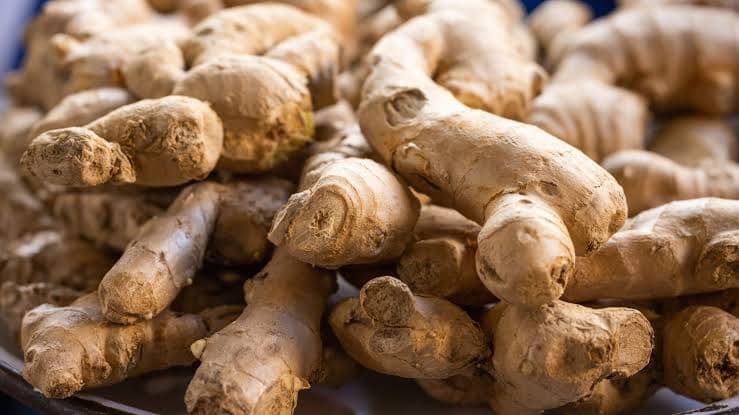
The price of ginger more than doubled over the past year, making it Ghana’s fastest-rising consumer item in June 2026, even as the prices of staples such as kontomire, maize and beans declined significantly.
According to the latest Consumer Price Index (CPI) report released by the Ghana Statistical Service, ginger recorded an annual inflation rate of 102.5%, followed by shrimps (90.8%) and mangoes (87.2%). Other food items posting sharp price increases included bananas (47.8%), avocado pears (43.8%) and fresh coconuts (39.3%).
The report also identified ginger as one of the country’s biggest contributors to overall inflation, accounting for 7.0% of headline inflation. Bus and trotro fares remained the largest driver at 10.5%, followed by rent payments (8.4%) and secondary school fees (7.2%).
However, not all food prices increased.
The Statistical Service reported that kontomire (alefu) recorded the steepest annual price decline of 38.0%, followed by garden eggs (-33.1%), maize (-32.1%), millet (-23.0%), pawpaw (-22.4%) and beans (-21.3%).
The sharp divergence in commodity prices came as food inflation edged up to 3.9% in June from 3.3% in May. Despite the increase, food accounted for 31.5% of headline inflation, compared with 68.5% for non-food items, indicating that price pressures were more pronounced outside the food basket.
Summarising the food price trends, the Statistical Service noted: “Food rose, but is not the main driver,” explaining that food inflation increased to 3.9% year-on-year but contributed 31.5% of headline inflation. It added that “Ginger was highest at +102.5%; Kontomire lowest at -38.0%.”
Overall, Ghana’s year-on-year inflation rose to 5.3% in June from 3.7% in May, although the monthly inflation rate slowed to 0.2%, suggesting the pace of price increases moderated during the month.